


If you’ve been running Facebook or Instagram ads for a while, you’ll know the feeling. You open Ads Manager, go to build a beautifully precise audience… and another option has quietly vanished.
Again.
No email heads-up. Just poof – another piece of detailed targeting gone, folded into something broader, or auto-expanded by default.
So when people say “another one bites the dust,” they’re not being dramatic. They’re naming a very real, very consistent shift we’ve been watching for about five years now.
Not the end of Meta.
Not the end of digital ads.
Just the end of the version of targeting we used to rely on.
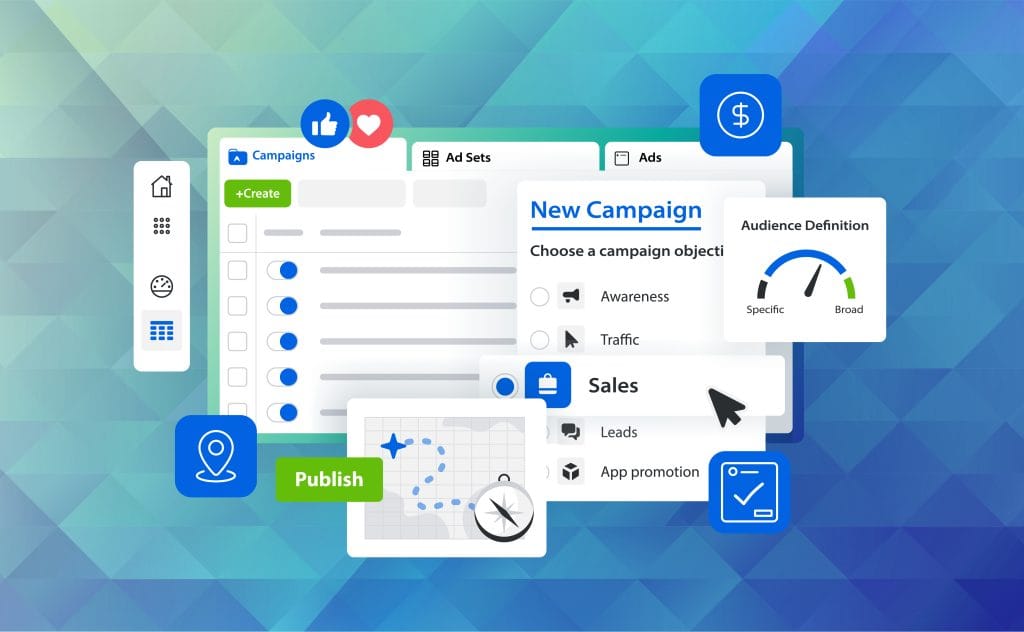
The last 5 years in one sentence
Platforms are moving away from human led micro-targeting and toward AI led delivery – partly because of regulation, partly because of signal loss and partly because that’s where their business model is heading. That’s the headline. Everything else is ripple effects.
What’s actually been removed or depleted?
Let’s zoom out.
2020–2021: the wobble years
iOS14 didn’t just make tracking harder – it made interest and behaviour targeting less reliable. Audiences started feeling “thinner.” Results got weirder. CPMs crept up. Meta began nudging advertisers toward broader audiences with more machine learning optimisation.
2022: the big clear-out
Meta publicly removed thousands of detailed targeting categories, especially those tied to sensitive topics (health, religion, politics, ethnicity, sexual orientation, and related organisations). Industry breakdowns estimate 5,000+ categories were affected in that wave. A genuine turning point. Not theoretical.
2023–2024: quiet consolidation
After the public removals came the slow fade:
- niche interests merged into broader ones
- behaviour sets simplified
- “Advantage” audience expansion appearing everywhere
- more campaigns effectively broad by default
Targeting didn’t just shrink, it got softer around the edges. And don’t get me started on the move to GA4 – We don’t have enough time for that haha.
Mid-2024 into 2025: exclusions removed
The most recent heavy hitter: Meta removed Detailed Targeting Exclusions for most campaign types. So while you can still include interest groups, you can’t say: “Show to these people but not those people.” At least not in the old, neat, controlled way. Meta says this improves performance. Often, it does. But it also removes a lever that mattered a lot for niche brands and smaller budgets.
Why it feels like regulation is stopping us reaching the right people
In part, it is. Privacy rules are tightening (especially in the UK/EU). Users are pushing back on profiling. Platforms are responding by limiting “sensitive” segmentation – and by leaning on AI models that don’t need to expose as much targeting detail to advertisers. But there’s another truth sitting beside it:
Meta also benefits from advertisers having fewer manual controls.
Broad + automated campaigns are easier to scale, easier to sell, and generally generate more spend. So what we’re seeing is a collision of forces:
regulation + signal loss + platform incentives. And that collision is reshaping the whole funnel.
This doesn’t make other channels obsolete
Let’s be clear: Facebook/Instagram ads still belong in the funnel.
They’re brilliant for:
- discovery and reach
- retargeting
- social proof
- fast testing
- scaling what works
What’s changing is where they sit and how you use them.
If targeting is broader, then:
- creative becomes the real filter
- first-party data becomes gold
- trust-building matters earlier
- niche brands need clearer qualification signals
Digital ads aren’t dying – they’re evolving upward in the funnel, becoming more about influencing and warming than pinpoint precision. And honestly? That’s not a bad thing. It just means strategy can’t be lazy.
The funnel keeps evolving (because humans do)
This is the bit most people miss:
Funnels aren’t fixed.
They’re a living response to tech, policy, culture, and buyer behaviour. Five years ago we built funnels around:
- micro targeting
- cheap clicks
- pixel-driven conversions
Now we’re building funnels around:
- broad reach
- smarter segmentation outside the platforms
- stronger creative storytelling
- trust signals
- multi-touch journeys
The funnel isn’t broken.
It’s just doing what it always does: adapting.
So where does direct mail fit in?
Not as the “replacement.” As the stabiliser. Direct mail doesn’t compete with digital ads – it complements them in a way that’s getting more valuable as targeting gets fuzzier.
Because direct mail is still:
- fully controllable (you choose the list)
- first-party by nature
- immune to algorithm shifts
- trusted and tangible
- ridiculously good at moving someone from “aware or even unaware” to “ready”
When digital gets broad at the top of the funnel, a beautifully targeted, personalised handwritten letter can do the job of:
- deep qualification
- trust-building
- conversion nudging
Basically, direct mail becomes the part of the funnel you don’t have to keep rebuilding every six months.
The real takeaway
Another one has bitten the dust. Targeting options are shrinking, and marketing keeps rearranging itself around that fact. But this isn’t a “digital is dead” sermon. It’s a “digital is different now” reality check.

The winners won’t be the brands who cling to old targeting tricks. They’ll be the ones who build funnels that use each channel for what it’s best at and keep evolving without losing their grip on who they’re actually trying to reach.
And that’s exactly why direct mail — especially handwritten direct mail IMO — is having a bit of a renaissance. Not because other channels don’t matter.
But because in a world of constant platform change, having one channel where targeting is still yours, is a very comforting thing.
If you liked this and want to find out more or download a handwritten sample pack to see what on earth I am banging on about, get in touch info@penwrittenpost.co.uk.
All the best
Daniella Paolozzi
(the one with pink hair and that last name most people cannot pronounce!)